24 November 2026
November 24, 2026
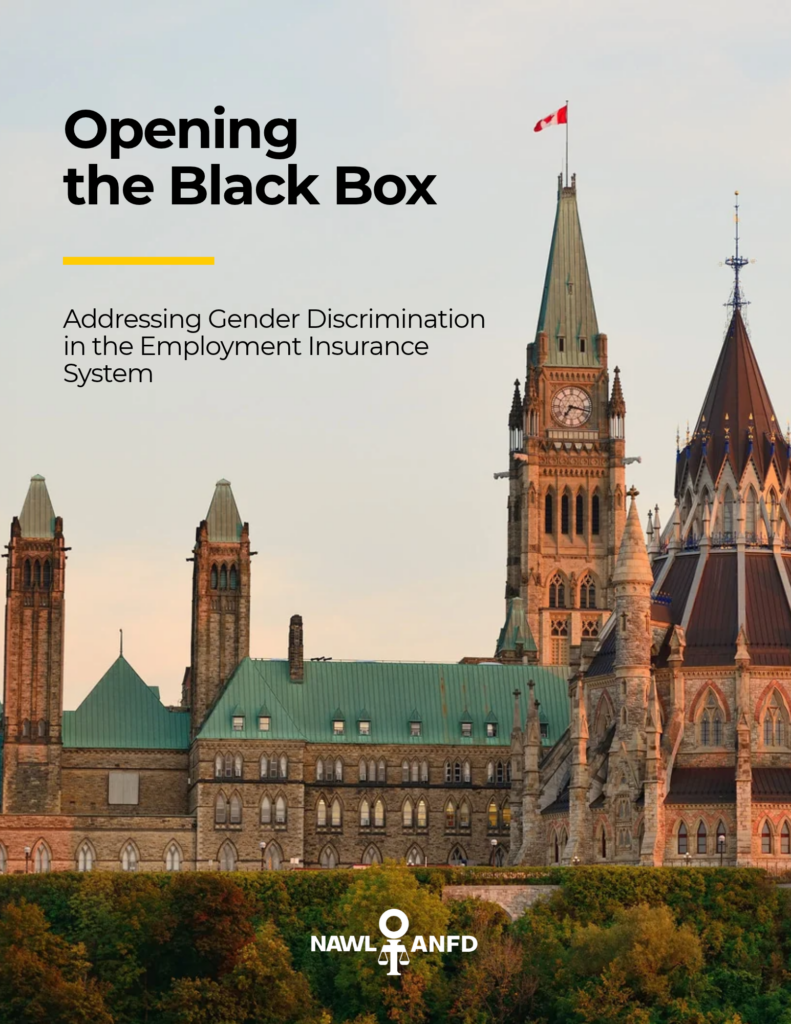
Anishinaabe Territory/Ottawa, November 24, 2026 – Gender discrimination is deeply embedded in Canada’s Employment Insurance (EI) system. That is the finding of a new report released today by the National Association of Women and the Law (NAWL), which makes 28 recommendations to make the program more equitable.
Opening the Black Box: Addressing Gender Discrimination in the Employment Insurance System examines how eligibility requirements, as well as benefit amounts and duration, penalize women across both EI regular benefits and maternity and parental benefits.
Gender disparities within EI are not the inevitable result of women’s individual employment choices. They are the consequences of policy decisions that have created an EI system that fails to account for the realities of women’s paid and unpaid work, particularly that of disabled women, Indigenous women, racialized women, and women experiencing intimate partner violence.
Decades of evidence, but little meaningful reform
The gender discrimination that pervades the EI system has been documented for decades, by parliamentary committees, feminist and labour organizations, and Employment and Social Development Canada (ESDC) itself. Despite overwhelming evidence and repeated calls for change, successive federal governments have failed to undertake meaningful reform so far. The report also shows that administrative complexity and program costs have repeatedly been invoked to justify keeping rules that disproportionately disadvantage women. “A system that is focused solely on keeping premiums down cannot adequately address gender equality, since it is always cheaper to discriminate against women than it is to support them,” says report author Amanda Therrien, Senior Staff Lawyer at NAWL.
Canada has already shown that a more equitable system is possible
Many of the solutions already exist, the report notes. During the COVID-19 pandemic, the federal government temporarily expanded access to EI by easing eligibility requirements and adjusting benefit rules. Women were among those who benefited most from these changes, demonstrating that targeted reforms can substantially reduce gender disparities. Quebec’s Parental Insurance Plan also provides an example of how a more accessible and flexible parental benefits system can better support families.
NAWL’s report sets out 28 concrete recommendations for legislative, regulatory and administrative reform. Several of them would simply restore rules that were in place before earlier EI reforms, or make permanent temporary measures that have already proven effective. “It is striking that, in 2026, women may have access to a less flexible and less gender-inclusive EI system than workers did before the 1996 reforms. A more equitable future for EI may actually mean taking a step towards the past,” says Therrien.
NAWL is now calling on the federal government to act and undertake the legislative reforms needed to ensure that EI provides fair economic security for all workers.

about NAWL
The National Association of Women and the Law is a not-for-profit feminist organization that promotes the equality rights of women through legal education, research and law reform advocacy.
Recent Updates
Nov. 24, 2026
New report exposes widespread gender discrimination in Canada’s Employment Insurance system
Nov. 19, 2026
Bill C-223: Committee slashes family law reform bill
Nov. 09, 2026